Field Equipment Guide
To help you get started as a producer, here is an overview of some of the field production equipment available to you at MetroEast.Equipment needs will change as your projects change. When you ask the Equipment Room (EQ) staff what equipment to take, they’ll ask what you’re planning to shoot. Doing a site check and knowing what you’ll be shooting will help in making equipment decisions. EQ staff can advise you on any additional equipment choices you may have. We’ll even provide a bag for you to put all those vital extras in.
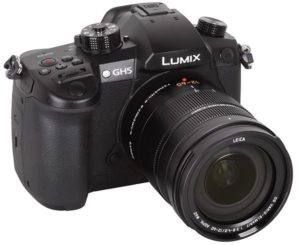
When you make a field equipment reservation you are automatically reserving a camera (with batteries and power supply) and a tripod. Here is a list of other equipment to consider:
AUDIO EQUIPMENT
Audio choices will depend on the kind of project you’re working on. Handheld microphones (aka mics), lavaliers (lapel mics), shotgun mics and boundary mics (PZM) all have specific purposes.
Handheld: These mics, as the name suggests, are for use in the hand or on a mic stand for vocals, stand-up interviewing, podium speakers and presenters, bands, etc. This type of mic is pretty versatile and could be used as a back-up in most situations. Handhelds need to be close to the sound source to achieve the best results.
Lavaliers: These mics clip onto the clothing of the person speaking (wired or wireless) for interviews, talk shows, podium speakers and presenters, or a host on the move. These smaller microphones do a good job of capturing an individual’s voice and rejecting background noise. They should be close to the sound source for best results.
Shotgun: This is a very directional microphone, generally used when a mic is not going to be seen in the shot. It is often used for field production, such as news shows, documentaries, etc. If you choose a shotgun mic, chances are you’ll need someone running audio for you and you’ll probably want a boom pole. This microphone must follow its audio source, and if hand-held there can be some handling noise.
Boom Pole: The boom pole allows you to place the microphone overhead, but still at a close distance, to the person(s) speaking on camera, keeping the microphone out of the camera’s view.
PZM or Boundary: This is an excellent microphone for panel discussions, theatre productions, choirs, piano, drums and large venues. Ideally a PZM needs to be mounted on a hard surface, (about 4ft x 4ft) such as a table, wall, floor, etc.
Current MetroEast microphones include:
Shure SM 58 (uni-directional) – handheld
Electro Voice 635 (omni-directional) – handheld
Sony ECM 44 or ECM 30 (omni-directional) – lavalier
Sennheiser EW 100 - lavalier or handheld (wireless kit)
Beyer Dynamic 86 N(C)S – shotgun
Realistic PZM
Mixer: MetroEast has a basic Shure field mixer with inputs for mixing up to four audio sources. For more information about this equipment, talk with EQ Room staff.
Cables: The most commonly used audio cables are XLR. MetroEast provides these in 25-, 50- and 100-feet lengths. If you think you’ll get a feed from an audio board, we have a variety of adaptors that cover most set-ups.
Remember, you’ll want to monitor your audio. Headphones are vital, and you’ll always need to do a sound check.
LIGHTING EQUIPMENT
Lighting is a very important part of your production. Introducing lighting in most situations will make a big difference visually. Being familiar with your location will help you make the right lighting decisions ahead of time.
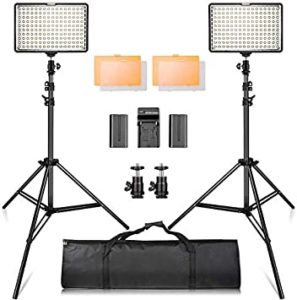
We have three basic light kits:
The two light-kit contains two Lowel Tota lights with umbrellas.
The three-light kit contains one Lowel Tota light and two Lowel Omni lights.
The four-light kit contains two Lowel Tota lights and two Lowel Omnis lights.
If you are taking a light kit out, grab some diffusion and/or gels. Diffusion helps knock down of soften a light, while gels add color and warmth to a scene. For an interview, a three- or four-light kit works best. We also recommend that you take some AC extension cords and a power strip – remember to try and pull power from two different circuits. The extension cord will help with this.
MONITORS
A monitor (aka television screen) can be a valuable addition to your equipment list. It will let you gauge the color and composition of your shot, and also lets other crewmembers or talent see your shot. Remember, you’ll need a BNC cable to go from the camera to the monitor.
TAPES
Because digital video tape can be expensive, we loan volunteers up to 8 DVCAM tapes at a time. Tapes can be checked out for 90 days at no cost. If you want to keep footage for a longer time, we also have tapes available for sale.
Please remember that equipment reservations are made on a first-come, first-served basis, so plan in advance. Some equipment is in limited supply.
To reserve equipment, call us at 503-667-8848 ext. 307. We’re open during these hours:
Monday 2PM – 10PM
Tuesday CLOSED
Wednesday CLOSED
Thursday 2PM – 10PM
Friday 2PM – 10PM
Saturday 11AM – 9PM
Sunday 11AM – 9PM
| Contact: | Equipment Room |
| Phone: | 503-667-8848 ext. 307 |
| email: | john@metroeast.org |
| Address: | 829 N.E. 8th Street Gresham, OR 97030 |